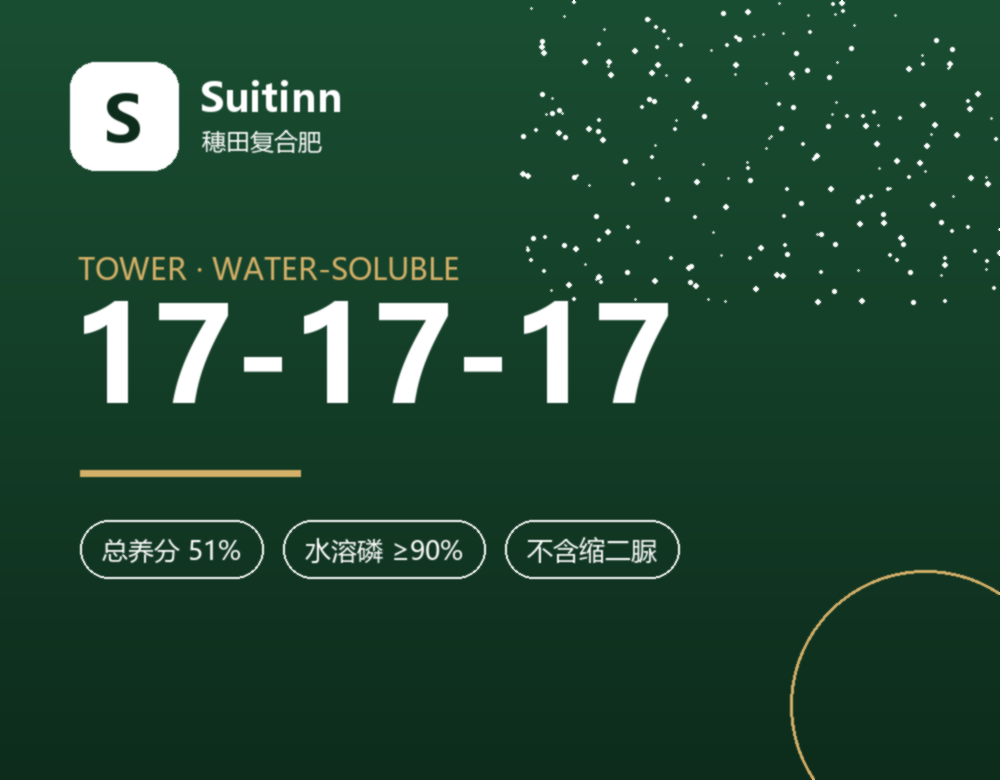
TOWER · WATER-SOLUBLE · 17-17-17
Water-soluble NPK 17-17-17
A tower-granulated NPK made from ammonium nitrate solution rather than urea melt: 90% water-soluble phosphorus, no biuret, and low insoluble content for drip and fertigation systems.
SPECIFICATION
Key figures
| N-P₂O₅-K₂O | 17-17-17 (51% total) |
|---|---|
| Nitrogen form | Nitrate + ammonium, high nitrate share |
| Process | Tower granulation, 120 m tower |
| Water-soluble P | ≥90% |
| Biuret | None — ammonium nitrate route, not urea |
| Water-insoluble content | Very low, suitable for drip lines |
| Granule | 1–3 mm, fast dissolving |
| Packing | 25 / 40 kg |
Ranges are typical; the contract and the lot report govern.
WHY IT MATTERS
Why nitrate-based grades suit sensitive crops
1. Nitrate nitrogen is taken up directly
Roots absorb NO₃⁻ without conversion, so it works in cold soils and in weak root systems. Ammonium nitrogen must first be nitrified, and local ammonia accumulation can burn roots. This grade carries both forms, balancing speed and persistence.
2. Biuret: the urea by-product
Biuret forms when urea is melted and granulated. It is phytotoxic — it inhibits root cell division and breaks down chlorophyll. Sensitive crops such as banana, citrus and vegetable seedlings react even at levels that pass national standards. A nitrate-sulphate grade contains none, by process rather than by control.
3. What 90% water-soluble P means
For drip systems the water-soluble share decides not just availability but also clogging risk. Insoluble material deposits at emitters and creates uneven flow across the field. Conventional-process monoammonium phosphate (72–73%) rather than slurry-process (55%) is what makes 90% achievable.
4. Tower granulation
Molten slurry is sprayed from the top of a 120 m tower and cools in free fall, producing round, uniform granules that dissolve faster than compacted or blended products.
DEFICIENCY
What goes wrong with the wrong nitrogen source
A deficiency is not a small yield loss; it accumulates from establishment.
- Biuret damage: yellow leaf tips and scorched margins on banana, citrus and vegetable seedlings; in severe cases the growing point dies.
- Ammonia burn: concentrated ammonium placement raises local pH and ammonia, browning roots and reducing fine root mass.
- Emitter clogging: insoluble material settles in drip tape, causing uneven discharge and patchy growth.
- Cold-soil stall: pure ammonium nitrogen nitrifies slowly in cold soil, so the crop looks fed but does not grow.
Easily confused with
- Old leaves firstmobile nutrients: N, P, K, Mg
- New leaves firstimmobile: S, Fe, Zn, Cu
- Margin scorchK deficiency or salinity
- Uniform yellowing, normal shapecheck sulphur
FIELD DATA
Specification comparison
Trial block received our product; control block received an imported brand at the same grade. Same field, same management.
| Site | Crop | Trial (Suitinn) | Control (imported) | Difference |
|---|---|---|---|---|
| Water-soluble P | — | ≥90% | 60–80% | +10 to +30 pts |
| Biuret | — | None | Up to 1% | Safer on sensitive crops |
| Water-insoluble content | — | Very low | Higher | Suitable for drip |
Trials carried out in China by our partner plant; results vary with soil, climate and management.
APPLICATION
Rates and timing
| Crop | Stage | Rate | Method |
|---|---|---|---|
| Banana | Flower differentiation to bunch emergence | 0.3–0.5 kg/plant per application | Fertigation or drip, every 10–15 days |
| Vegetables | After transplanting to harvest | 75–150 kg/ha per application | Fertigation or drip |
| Fruit trees | Fruit sizing | 0.2–0.4 kg/tree per application | Ring trench then irrigate |
Before using in a drip system, dissolve a sample in your own water and check for residue.
FAQ
Common questions
Water-soluble or just high water-soluble P?
They differ. A granule can carry 90% water-soluble P and still contain other insoluble components. For drip, ask for the water-insoluble content of the whole product.
Why emphasise zero biuret?
Because biuret damage is irreversible within a season and is easily misdiagnosed as salinity or disease. Removing it at the source is simpler than managing it.
Can it be combined with MKP?
Yes. A common programme is MKP foliar plus this grade through the drip line during fruit sizing.
Need this grade for your market?
Send the crop, the grade and the destination port. We reply within one working day.
Request a quote